
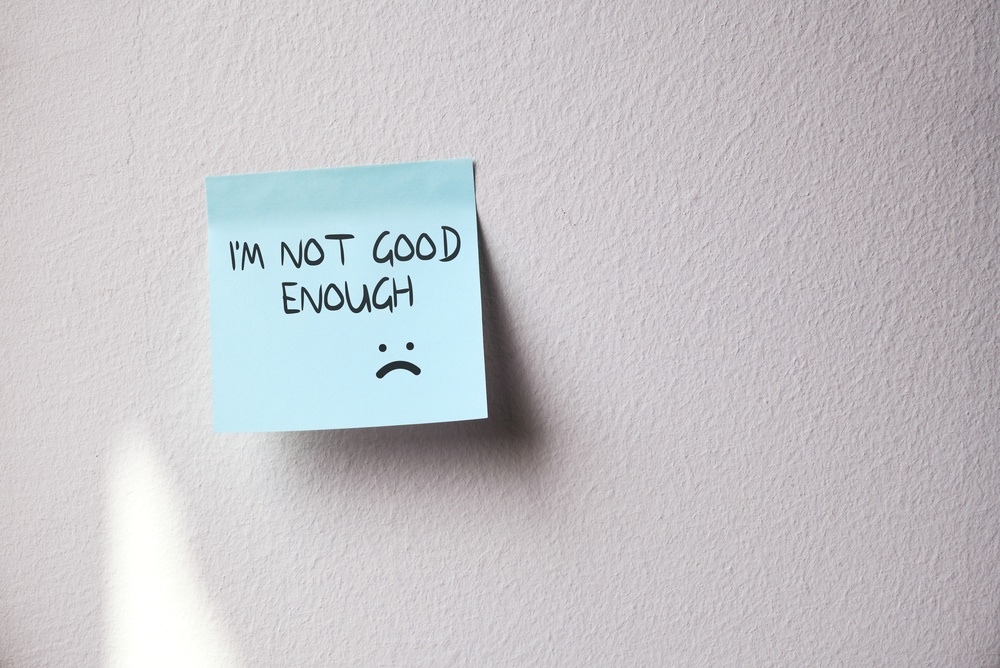
Low self-worth doesn’t always look like low confidence.
Sometimes it looks like over-achieving.
People pleasing.
Perfectionism.
Hyper-independence.
Staying quiet.
Accepting less than you deserve.
Or repeatedly pushing away the very things you want.
When part of us carries a deep belief that we aren’t enough, it can quietly influence the way we see ourselves, our relationships and the choices we make.
And sometimes, without realising it, those patterns can become a form of self-sabotage.
Where do these beliefs come from?
Our sense of ourselves develops through our experiences and relationships.
If you grew up being frequently criticised, dismissed, compared with others or made to feel that your achievements were never quite enough, you may have learned to see yourself through that lens.
Perhaps you had to work hard for approval.
Perhaps your needs didn’t receive much attention.
Perhaps you were bullied or excluded.
Perhaps you became the child who didn’t cause trouble because there was already so much going on around you.
None of these experiences automatically determine who you become.
But experiences can shape the expectations we carry forward.
Overtime, thoughts such as:
I’m not enough.
I’m difficult to love.
I don’t matter.
I have to prove myself.
can become deeply familiar.
And eventually, they can stop feeling like thoughts.
They can start feeling like facts.
When familiar beliefs influence our behaviour
If you expect that people will eventually reject you, you might find yourself holding back in relationships or pushing someone
away before they have the opportunity to leave.
If you don’t believe your needs are important, you might struggle to set boundaries or continually put other people’s needs before
your own.
If you believe you’re not good enough, you might dismiss compliments while immediately believing criticism.
And if you believe your worth depends on what you achieve, you might spend years trying to prove yourself — even when everyone around you can already see how much you’re doing.
From the outside, these behaviours can look confusing.
Why would someone push away a healthy relationship?
Why would they accept treatment they don’t deserve?
Why would they find criticism so believable but struggle to accept praise?
But when we understand the pattern, the behaviour can begin to make more sense.
The brain tends to notice what feels familiar
Our emotional brain is constantly taking in information and trying to work out what is safe, familiar and important.
If you’ve spent a long time expecting criticism or rejection, information that fits that expectation may feel particularly convincing.
A compliment might be dismissed:
“They’re only saying that.”
But criticism can feel like confirmation:
“I knew I wasn’t good enough.”
This doesn’t mean that your brain is deliberately trying to create painful situations.
It means that familiar patterns can become powerful.
And what was once a way of protecting yourself may no longer be helpful in your adult life.
Changing the pattern
The first step isn’t necessarily to force yourself to think positively.
It’s to notice the pattern.
To recognise the moments when an old belief is influencing what you do.
To begin asking:
Is this actually true?
Is this familiar, or is it helpful?
What would I do differently if I believed I was enough?
What would happen if I allowed myself to have needs and boundaries too?
Changing deeply established patterns takes time.
But when you begin to understand where they came from, recognise how they show up today and experiment with responding differently, you create the possibility of something new.
You don’t have to spend your life proving that you’re enough.
You can begin to build a life from the understanding that you already are.